Munia Ahmed
Biomedical engineering
Hometown: Gilbert, Arizona, United States
Graduation date: Spring 2027
Additional details: Honors student

GCSP research stipend | Fall 2025
Evaluation of Aging of Calcium and Phosphate Sol-gel Precursor Solutions of Conformal Orthopedic Hydroxyapatite (HA) Implant Coating Quality
Given developments in advanced biomaterials, there is a growing interest in replacing metal with non-metal fixation devices. This study is a continuation of an initial FURI project where the natural bioceramic, hydroxyapatite (HA), was synthesized by sol-gel chemistry technology using calcium nitrate tetrahydrate and triethyl phosphate precursors. The goal of this project is to determine if viscosity measurements, made at various times during the gelation process, is a useful indicator of HA-derived dip coatings. Sol gel-derived HA dip coatings, derived from sol-gel solutions at different gelation times and viscosities, and further processed with heat treatment using a muffled furnace, were evaluated for HA coating quality. Sol-gel precursor mixtures at various stages of gelation were evaluated using contact angle and Fourier Transform Infrared Spectroscopy (FTIR) measurements, while HA coating quality was assessed with microscopy and X-ray diffraction (XRD) measurements. HA dip coating quality was analyzed statistically to determine if viscosity measurement is a good indicator of sol-gel processing conditions and enhanced dip coating quality.
Mentor: Vincent Pizziconi

It’s hip to be square.
Students presenting projects at the Fulton Forge Student Research Expo are encouraged to download this personal QR code and include it within your poster. This allows expo attendees to explore more about your project and about you in the future.
Right click the image to save it to your computer.
Featured project | Fall 2025
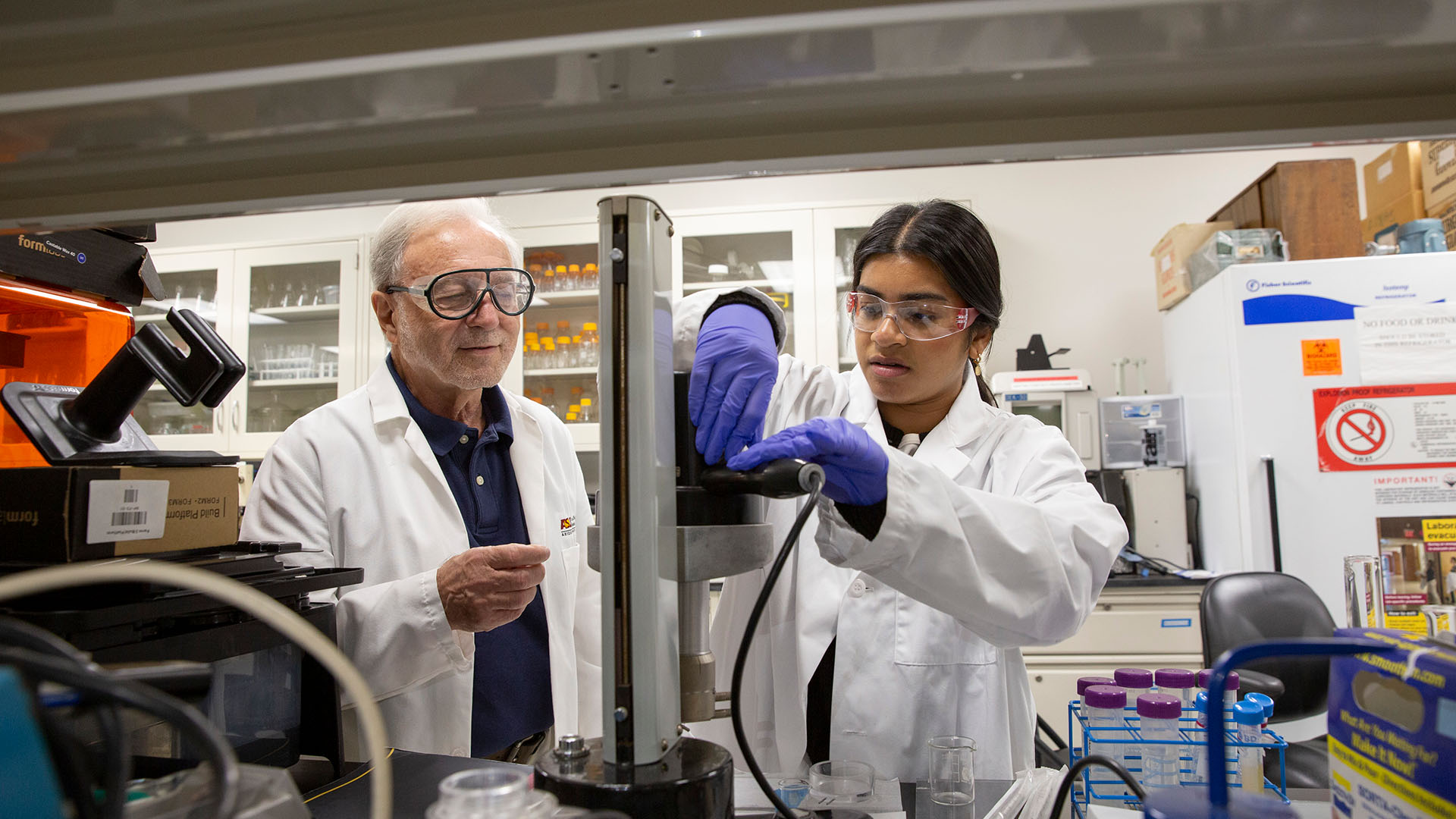
As a GCSP student, biomedical engineering major Munia Ahmed got involved in the research stipend program to deepen her experience in research. Working with Vincent Pizziconi, a Fulton Schools associate professor of biomedical engineering, Ahmed is investigating how well a special type of gel formulation for orthopedic implant coatings ages during use.
What made you want to get involved in this program? Why did you choose the project you’re working on?
I wanted to get involved in the GCSP research stipend program because it offers an incredible opportunity to continue pursuing research with the support and resources necessary to explore meaningful questions. After participating in FURI for the past two semesters, I knew I wanted to continue securing funding to build on my project and further develop my skills. This program allows me not only to follow my curiosity but also to contribute to impactful advances in health innovation. I chose my current project because of my strong passion for regenerative medicine and biomaterials research, and being part of the Laboratory of BioInspired Complex Adaptive Systems at ASU has continually fueled my motivation and deepened my commitment to this field.
What has been your most memorable experience as a student researcher in this program? Did you have a particular “aha!” moment during your project?
It’s fun seeing all the literature searches and research you’ve been doing come to life once you undergo your own experiment. It makes you realize that unexpected things can happen in the lab, and that it’s important to not take things so seriously and figure out why something is happening rather than give up!
How do you see this experience helping with your career or advanced degree goals?
I see this experience as an important step in preparing for graduate school and advancing my research career. I am strengthening my ability to think critically about scientific problems, design experiments and independently carry out a research project from start to finish. These experiences and skills are important, whether I’m going into industry or pursuing a higher degree. Working in regenerative medicine and tissue engineering also allowed me to explore different research areas that I can pursue as a biomedical engineering major and helped me build a strong technical foundation.
What is the best advice you’ve gotten from your faculty mentor?
Professor Pizziconi always gives really great advice, but the one thing he asks the lab members and I to think about is the “why” in your project. He consistently reminds our lab to look beyond the technical details and reflect on the bigger purpose of our work. This perspective has pushed me to approach my research with intention.
Why should other students get involved in this program?
Other students should get involved in the GCSP research stipend program or FURI because they provide a unique opportunity to pursue research with both independence and support. The GCSP research stipend not only offers funding but also encourages students to connect their curiosity to real-world challenges, making their work more meaningful. It allows you to take ownership of a project, develop valuable critical thinking skills and gain experience that prepares you for graduate school or a career in research and innovation.
