Q&A with faculty mentor Heejin Jeong
Posted on: October 27, 2025
Posted on: October 27, 2025
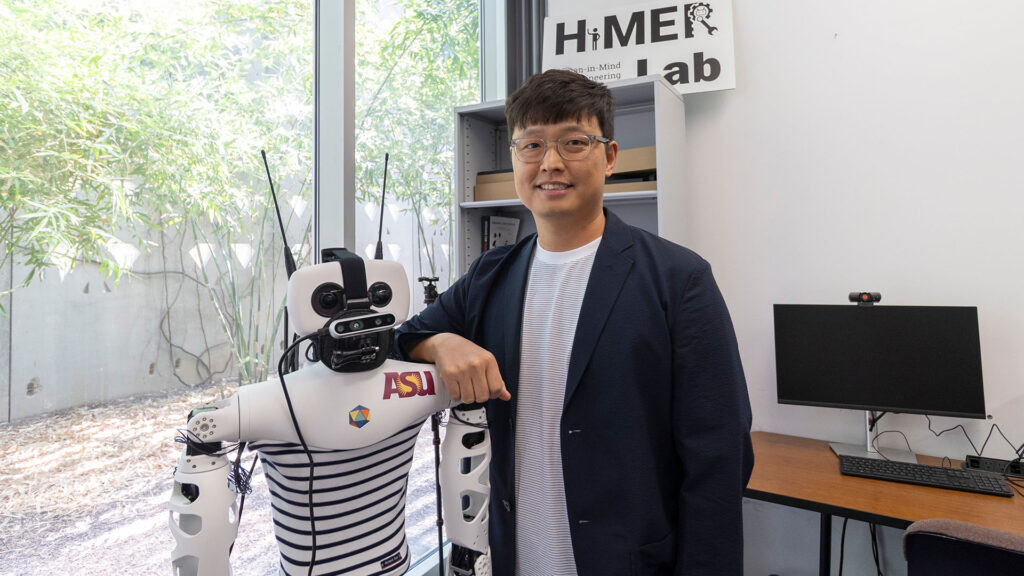
Heejin Jeong is an assistant professor of human systems engineering in The Polytechnic School. Jeong’s research focuses on human decision-making in interactions with autonomous and intelligent systems, including those powered by artificial intelligence, or AI. He also investigates the use of extended reality technologies, such as augmented reality, or AR, and virtual reality, or VR, for occupational safety and health care rehabilitation training, and human-robot collaboration in manufacturing systems. Jeong began mentoring student researchers for the MORE program in 2024.
What made you want to get involved as a FURI, MORE and GCSP research stipend faculty mentor?
I decided to become a mentor because I wanted to provide students with structured opportunities to conduct research and present their work professionally. Participating in the FURI and MORE programs allows me to guide students through key research milestones while helping them develop essential skills for independent inquiry.
From a broader perspective, I was also interested in supporting research aligned with the Fulton Schools’ core research themes and contributing as a Fulton Schools faculty member. Since I began as a mentor for the MORE program, I have worked with three students on projects related to human-computer interaction, human-robot teaming and extended reality applications.
What is your favorite part about seeing your students conduct research?
My favorite part is witnessing students grow in confidence and independence. Many begin the program uncertain of their abilities, but by the end, they can clearly and confidently explain their research to others.
It’s particularly rewarding to see them take ownership of their projects, defining problems, designing methods and interpreting results. Watching that transformation from “Can I really do this?” to “I know how to tackle this challenge” is one of the most fulfilling aspects of mentorship.
How have your FURI, MORE and GCSP research stipend students had an effect on your research? Have they come up with any research surprises or proposed new directions for your lab?
The research conducted by my MORE students often serves as a pilot study for larger ongoing projects in my lab. Their work helps establish foundational data and directions for future proposals.
For example, one student’s work on enhancing spatial awareness in teleoperated robots using depth sensing and AR inspired our lab to explore language-vision learning frameworks that improve operator control and situational awareness in high-stakes VR teleoperation. This progression illustrates how student projects can drive meaningful new research directions.
In this way, student-led research not only supports our ongoing work but also sparks innovative ideas that expand the scope of our lab’s research agenda.
What have you gained from being a FURI, MORE and GCSP research stipend mentor? How has the experience been rewarding for you?
It’s incredibly rewarding to watch students evolve throughout the semester, from being hesitant at first to confidently presenting their findings in front of peers and faculty. The transformation in their communication skills and research mindset is remarkable.
Personally, I find deep satisfaction in knowing that my guidance helped them build the confidence to pursue advanced research opportunities, whether that’s graduate study or industry research roles.
What advice would you give to students who might be interested in participating in FURI, MORE and the GCSP research stipend program?
First, choose a topic that truly excites you. Passion for your subject is what sustains you through the challenges of research. Next, find a faculty mentor whose expertise and mentoring style align with your goals.
Because the program lasts only one semester, it’s important to set a realistic and achievable scope. Also, think of it as a steppingstone; use the experience to build a foundation for future work, such as a master’s degree thesis or even a doctoral project. The most successful students are those who see the program not as an end, but as a beginning.
Why should other faculty members become FURI, MORE and GCSP research stipend mentors?
These programs provide an excellent opportunity to support students’ research interests while also benefiting ongoing faculty projects. Even if a lab has limited funding, the stipend support enables students to participate meaningfully in research.
Faculty members can use these projects as pilot studies to test new ideas or assess whether a student may be well-suited for future graduate research positions. Most importantly, mentoring in these programs fulfills our responsibility as faculty members at a research university to nurture the next generation of researchers and innovators.
Is there anything else that you want to mention about your time as a FURI, MORE and GCSP research stipend faculty mentor?
Providing research opportunities for undergraduate and master’s degree students is one of the most important roles of a research university professor. While mentoring can be time-intensive, the Fulton Schools’ structured support, such as milestone tracking, research abstract guidance and poster presentation workshops, makes the process much smoother for both students and mentors.
Overall, I see these programs as a mutually enriching experience that fosters growth, collaboration and innovation for both students and faculty.
Professor Jeong has been an outstanding mentor this semester. He always takes time to explain complex research ideas clearly and guides me with patience and encouragement.
Bhairavi JangaleUser experience MORE student